

The crazy world of placing the stress in Russian
Most foreigners learning Russian struggle a lot trying to distinguish where to put the stress in a word. And, in fact, sometimes, you simply have to memorize it by heart.
In Russian, the stress in a word has many functions. Some of them you probably couldn't even imagine!
- to differentiate the sense of the words
‘а́тлас’ means ‘atlas’, while ‘атла́с’ means ‘satin’. - to define the style
‘ко́мпас’ is the literary norm for the word ‘compass’, while ‘компа́с’ is the professional term for the same notion. - to show the different forms of the word:
‘нет струны́’ (‘no string’; singular, Genitive case) – ‘стру́ны’ (‘strings’; plural, Nominative case)
Even grammatically, equal words don't have common rules for how the stress changes when their forms change.
But here are some tips and secrets:
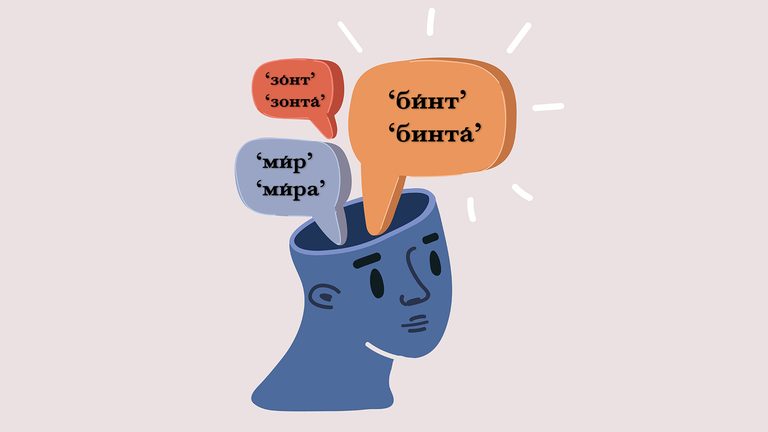
Many monosyllabic nouns in masculine gender change the stress to the last syllable in Genitive case:
- ‘би́нт’ (Nom.) – ‘бинта́’ (Gen.) – ‘bandage’
- ‘зо́нт’ (Nom.) – ‘зонта́’ (Gen.) – ‘umbrella’
But others, in opposite, save the stress:
- ‘ми́р’ (Nom.) – ‘ми́ра’ (Gen.) – ‘world’/’peace’
If you are learning Russian and eager to know more about the language rules and curious facts, watch the 'Orthocontrol' series by the 'Russky Mir' TV company. Where to put stress, where a comma should be, how Russian has borrowed words from other languages. You'll discover these topics and much, much more!