

How foreign names are spelled & pronounced in Russian

Many foreign titles and names used to be pronounced and written quite differently before (and sometimes very unlike the original). And many of those weird examples still exist today.
The Franklin & Washington case
The name of one of the founding fathers of the United States, Benjamin Franklin was rendered not by transcription or transliteration, but with the help of the variant ‘Вениамин’, more familiar to the Russian ear. In English, that would be pronounced ‘Veniamin’.
A frequent problem in foreign names is stress. The capital of the United States, Washington, is named after George Washington, the country's first president. In English, the stress in this word falls on the first syllable. But, in the 18th century, the language of international communication was French, so the names of famous people were customarily pronounced in the French manner. Thus, the stress variant ‘Вашингто́н’ became established in Russian.
At the same time, today the ‘Dictionary of Proper Names of the Russian Language’ records different stress in the word ‘Вашингтон’, depending on whether one is talking about the person or the city: ‘Джордж Ва́шингтон’, but the capital of the U.S. is ‘Вашингто́н’.
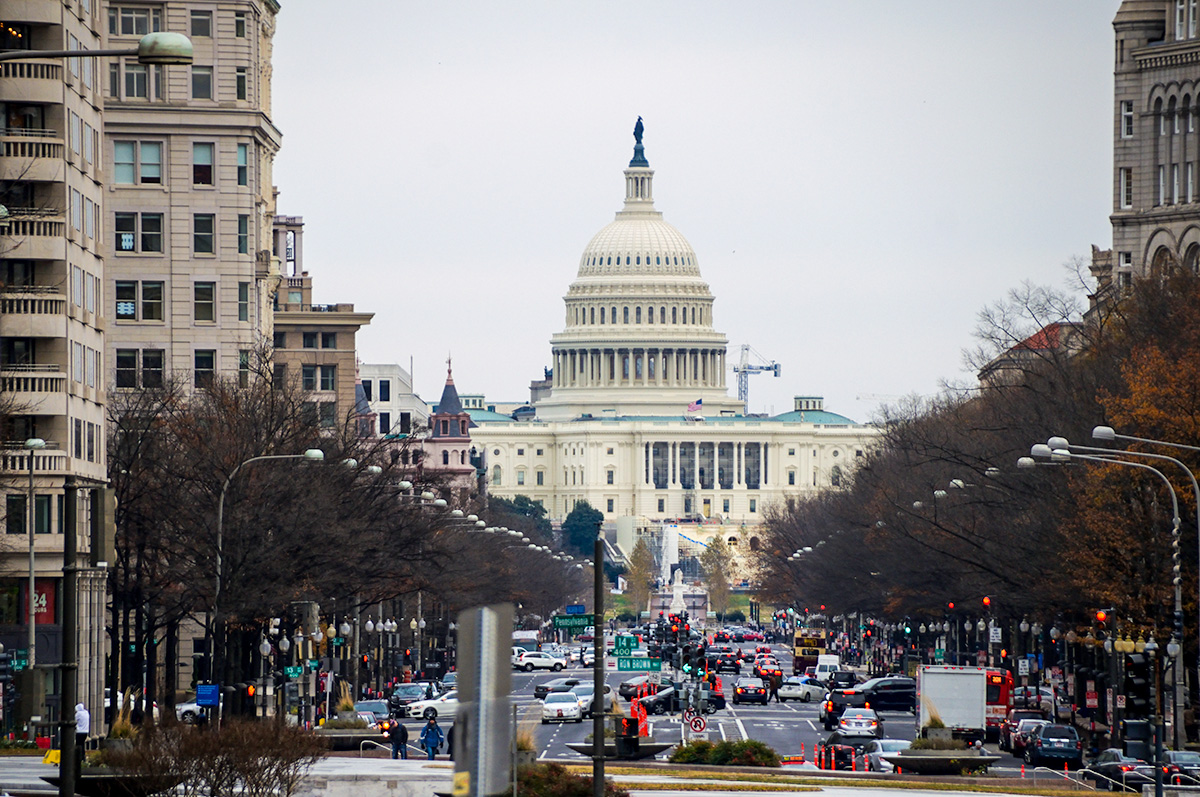 United States Capitol in Washington DC
A similar story happened with the last name of English physicist, mathematician and astronomer Isaac Newton. The English Newton in the 18th century was rendered in Russian as ‘Невтон’, but, over time, the variant ‘Ньютон’ won out.
From this last name comes the unit of measurement – the newton. What about its stress? It's complicated! The ‘Great Dictionary of Stress’ recognizes the variants ‘нью́тон’ and ‘ньюто́н’ as equally valid. At the same time, other dictionaries insist on opposite variants.
In the names ‘Артур’ (Arthur) and ‘Альберт’ (Albert), the stress may fall on either the first or the last syllable. Dictionary recommendations are not uniform and depend on the source language: А́ртур Миллер (Arthur Miller), but Арту́р Шопенгауэр (Arthur Schopenhauer), А́льберт Гор (Albert Gore), but Альбе́рт Эйнштейн (Albert Einstein).
How Harry Potter became Garry Potter
In past eras, many people in Russia pronounced the letter 'Г' as a voiceless fricative 'H' [ɣ] (today, this is characteristic of South Russian dialects). That’s why the English ‘Harry’ was written in Russian as ‘Гарри’ – i.e. ‘Garry’! While the German Hans and Heine became ‘Ганс’ (Gans) and ‘Гейне’ (Geine).
 A Russian translation of 'Harry Potter'
At a later stage in the development of the Russian language, the versions ‘Харри’ and ‘Ханс’ appeared, too. And, for example, Beethoven began to be written and pronounced as ‘Бетховен’ only from the 19th century – before that, it was ‘Бетговен’!
The Spanish name ‘Juan’ was often transliterated in Russian as ‘Жуан’ (Zhuan), but now it is rendered as ‘Хуан’; however, in ‘The Stone Guest’, Alexander Pushkin uses the variant ‘Гуан’ (Guan).
Indian difficulties
Two variants of stress in the name of the Indian god of fire Agni continue to coexist: ‘А́гни’ and ‘Агни́’ (in Sanskrit: अ॒ग्नि). By the way, this name and the Russian word for fire ‘огонь’ come from the same Proto-Indo-European root!
Brahmā, another Indian deity, the demiurge who creates the universe from primordial matter, bears the name ‘Бра́хма’ (in Sanskrit: ब्रह्मा). But, earlier, he was called ‘Бра́ма’ (without an ‘H’). A similar example is the outdated name for the highest Indian varna of Brahmins – ‘брамины’. Apparently, it was previously considered inconvenient to pronounce the combination [‘HM’] with aspiration.
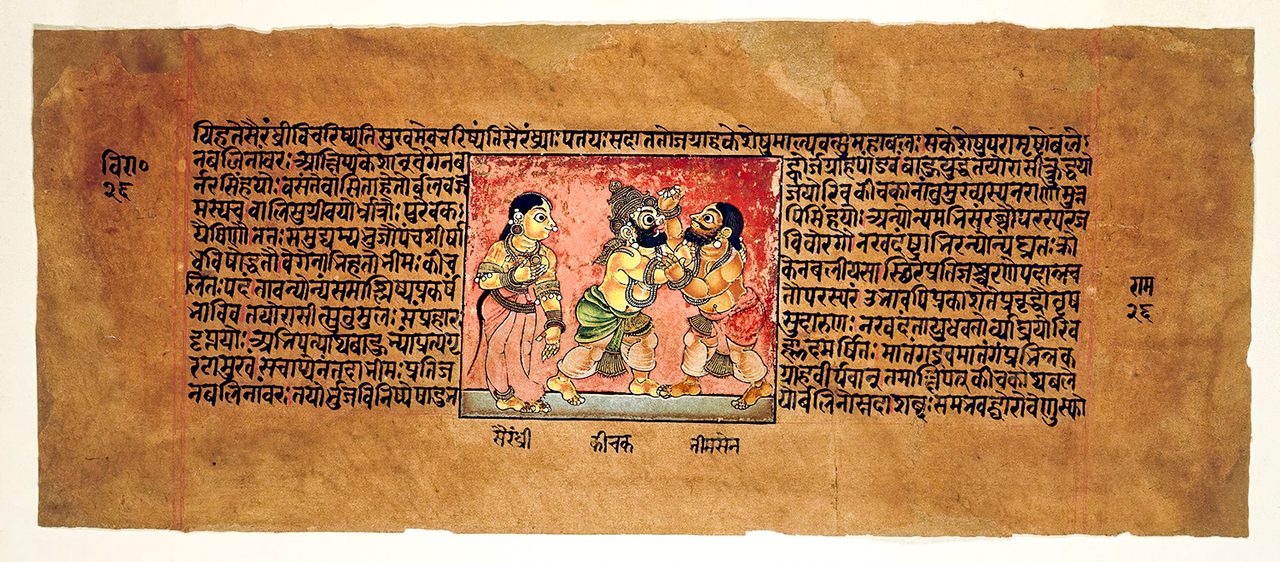 Kichaka and Bhimasena, Folio from a Dispersed Mahabharata Series, 1670
The name of the ancient Indian epic ‘Mahabharata’ is not called ‘Махабхарата’ in Russian, but beforehand it has such options of spelling as ‘Магабарата’ and ‘Магабхарата’.
In Russian, in the name ‘Sri-Lanka’ the stress may be placed either on the penultimate syllable (Шри-Ла́нка) or on the last (Шри-Ланка́). This name is translated from Sanskrit as 'blessed land'.
Chinese nuances
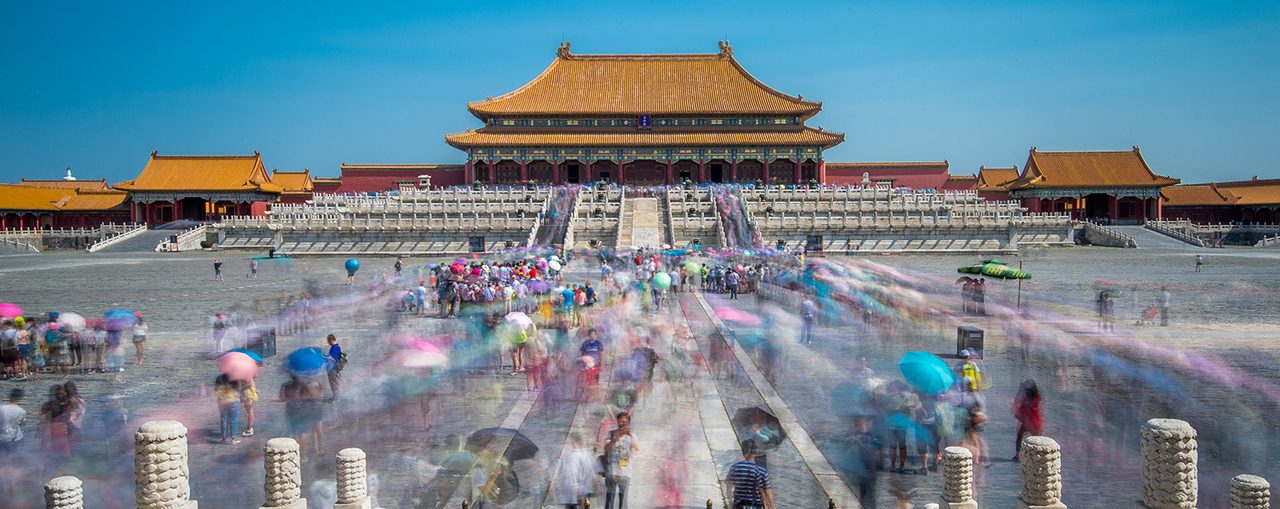 Tourists in Beijing, China
The name of the city Beijing goes back to the Chinese 北京 [Běijīng], which means ‘northern capital’. It entered the Russian language as ‘Пекин’ (‘Pekin’) through Western European languages; Europeans, in contact with speakers of South Chinese dialects, adopted the forms Pachin, Paquin, Pekin, Pequin and the like. At the same time, the residents of Beijing themselves and speakers of literary Chinese (Putonghua) pronounce the name of the capital differently.
In the period from 1368 to 1421 (at the beginning of the Ming dynasty) and in modern history – from 1928 to 1949 – the city bore the name ‘Бэйпин’, from the Chinese 北平 [Běipíng], meaning 'northern peace'. So, despite the similarity, the etymology of these words differs.
Sometimes in Russian, one can encounter a variant closer to the standard Chinese pronunciation: ‘Бэйцзин’ (‘Bejtsin’). For example, the name of the ‘Beijing Daily’ newspaper is ‘Бэйцзин жибао’ in Russian (‘Bejtsin zhabao’), while the ‘Beijing evening’ newspaper is called ‘Бэйцзин ваньбао’ in Russian (‘Bejtsin vanbao’). Just like the soccer club ‘Beijing Guoan’ is pronounced as ‘Бэйцзин Гоань’ (‘Bejtsin Goan’).
A full version of the article can be found (in Russian) on the Gramota.ru (Грамота.ру) website.