With these Russian phraseological units, you can travel… TO THE END OF THE WORLD!
A map won't help. To find your way, you'll need to know these Russian expressions!
Read more about expressions with place names here. Let's move on to the next level: exploring how far the Russian language can take you.
1 “Загнать за Можай.” (“Zagnat za Mozhay.”)
"Drive beyond Mozhay."
Send very far, put the enemy to flight.
In the old days, freethinkers and other disgraced individuals were sent beyond Mozhay (today Mozhaisk). So, in the minds of most, this city was quite far away.
According to one account, the expression “drive them past Mozhaisk” originated in the 17th century, when the troops of Minin and Pozharsky were pushing the Polish invaders back toward the territories of the Polish-Lithuanian Commonwealth. The enemy forces retreated toward Smolensk, passing, among other places, Mozhaisk. During the Patriotic War of 1812, the idiom became popular again, but, this time, in connection with Napoleon’s retreat from Russia.
2 “К черту на кулички.” (“K chertu na kulichki.”)
"To hell on kulichki."
In the middle of nowhere, into uncharted wilderness. ‘Kulichki’ was the name for swampy areas in the forest: people believed that all sorts of evil spirits (including devils) inhabited such places. You can read more about this idiom here.
3 “Послать на Кудыкину гору.” (“Poslat na Kudykinu goru.”)
"Send to Kudykina Mountain."
If someone responds to you this way, know this: they’re hinting that you’re too nosy and sticking your nose where it doesn’t belong. In ancient times, ‘Kudykin Mountain’ referred to places where pagan rituals were held. And ‘kudyka’ was the term for those who asked inappropriate questions.
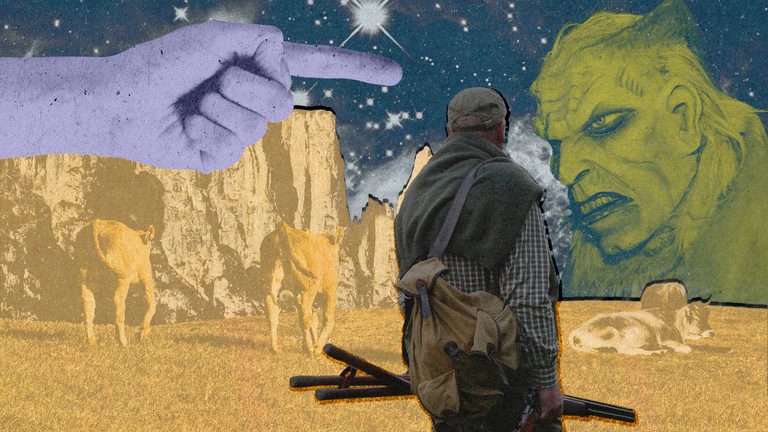
Usually, hunters, when setting out on a hunt, wouldn’t say exactly where they were going so as not to jinx their luck. Instead, they’d joke, “to Kudykinа Mountain”. Over time, other superstitious people began to do the same.
By the way, you can still find Kudykina Mountain on the map.
4 “В глушь, в Саратов.” (“V glush, v Saratov.”)
“Into the wilderness, to Saratov.”
More precisely: “To the village, to my aunt, to the wilderness, to Saratov.” – that’s how the hero of Griboyedov’s ‘Woe from wit’ reasoned about escaping the temptations of Moscow. The phrase has become a popular saying.
5 “Куда Макар телят не гонял.” (“Kuda Makar telyat ne gonyal.”)
“Where Makar never drove his calves.”
To remote places. Scholars believe that originally this phrase might have referred to a poor man, who was hired to tend livestock on the worst and most remote pastures. But, over time, the expression came to be used to emphasize remoteness from civilization.
6 “За тридевять земель.” (“Za tridevyat zemel.”)
“Beyond the Far Far Away.”
At the ends of the earth. That is exactly where fairy-tale heroes set off in search of the thirty-ninth kingdom or the thirtieth realm.