
What did the first Russian car look like?
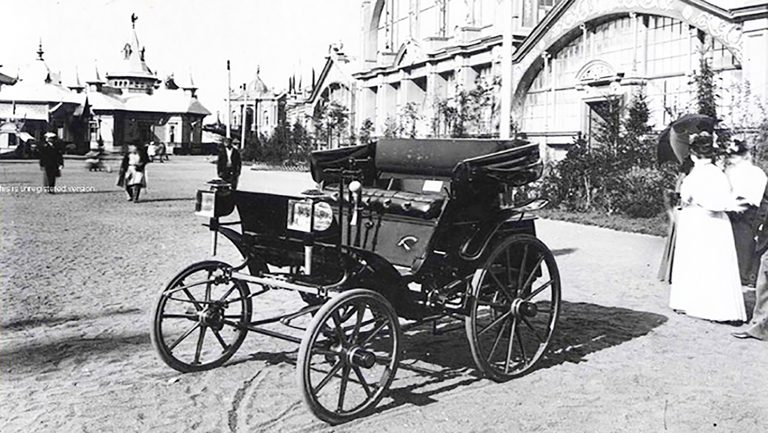
The two-seater ‘Self-Propelled Carriage’ could reach a top speed of 20 km/h and its gasoline fuel capacity was sufficient for 10 hours of non-stop driving.
The first Russian automobile was unveiled to the public on July 14, 1896, at the 16th ‘All-Russian Industrial and Art Exhibition’ in Nizhny Novgorod. Pyotr Frese and Yevgeny Yakovlev's ‘Self-Propelled Carriage’ was a joint development between the designers’ two companies. The body, chassis and wheels were manufactured by Frese's factory, while the engine and transmission were manufactured by Yakovlev's plant.
Externally, the vehicle strongly resembled a ‘proletka’ – an open horse-drawn carriage. It weighed approximately 300 kg and was equipped with a 2-horsepower internal combustion engine cooled by water. The wheels were wooden, with rubber tires; the rear wheels were larger than the front ones. The two-seater vehicle could reach a top speed of 20 km/h and its gasoline fuel capacity was sufficient for 10 hours of non-stop driving.
Yakovlev and Frese lived in St. Petersburg, but met at an exhibition in Chicago in 1893. One had already established production of internal combustion engines in Russia, while the other was successfully designing horse-drawn carriages. So, the entrepreneurs decided to join forces. Their collaboration continued until Yakovlev's death in 1898. His heirs reoriented the factory and Frese was forced to seek engines abroad. In 1810, he sold his company to the Automobile Division of the Russo-Baltic Wagon Plant and retired.
The fate of the first ‘Self-Propelled Carriage’, as well as the number of cars produced in its likeness, remains unknown.