
Why did Ivan the Terrible’s sons become saints?
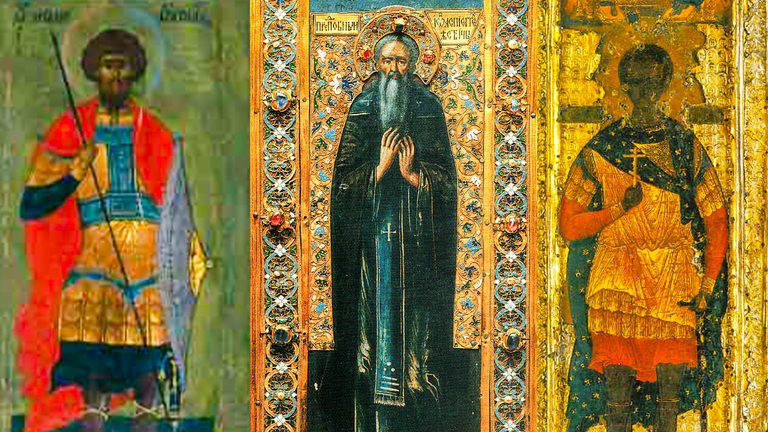
The tsar had eight children – five sons and three daughters. However, most of them died in infancy or early childhood.
Three of the tsar’s sons – Ivan, Feodor and Dmitry – survived to adulthood. The latter two were canonized, though for different reasons and at different times.
Tsar Feodor Ivanovich (1557–1598)
Feodor was born to Ivan the Terrible’s first and beloved wife, Anastasia Romanovna. After his father’s death in 1584, he inherited the throne and became the last tsar of the Rurik dynasty.
Feodor went down in history as "the Blessed". Contemporaries described him as a meek, deeply religious man with little interest in affairs of the state. His father gave him the nickname the ‘Bell-Ringer’, because of his passionate love for ringing bells; he would often climb the bell tower and ring the bells himself.
According to some accounts, Feodor also inherited his father’s passion for brutal contests – such as fistfights and man-versus-bear matches.
In reality, however, power during his reign lay in the hands of Boyar Boris Godunov, his brother-in-law. Yet, this did not mean Feodor was incapable of ruling. For instance, he personally participated in the establishment of the Patriarchate in 1589 and in the war against Sweden.
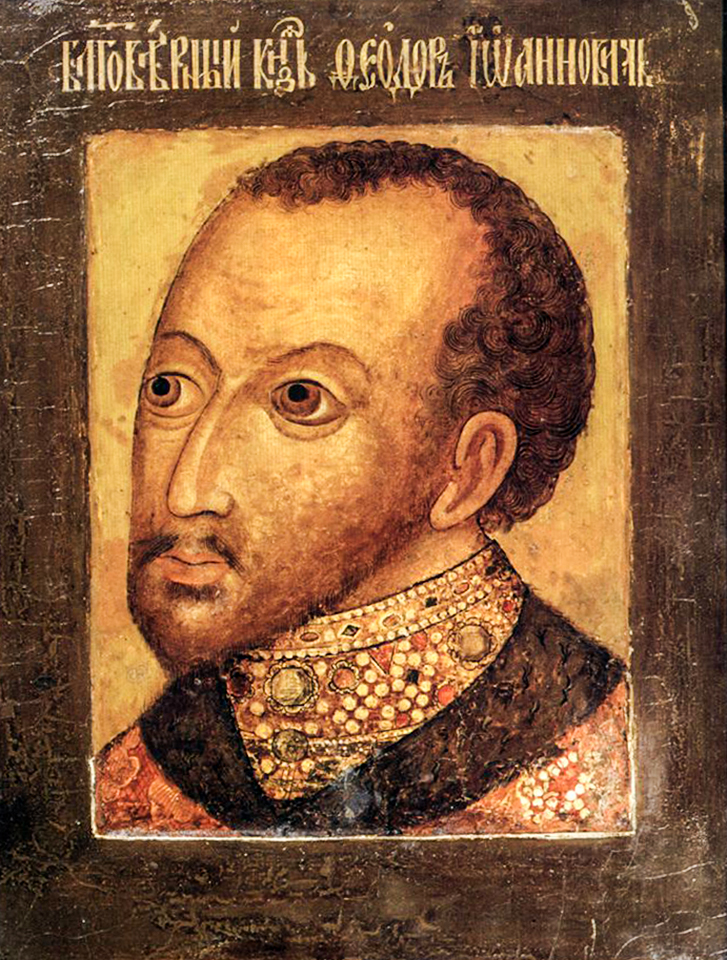 Portrait of Fyodor Ivanovich (1630s) from the tombstone in the Archangel Cathedral of the Moscow Kremlin
And yet, his contemporaries viewed him not so much as a politician, but as a righteous man. His life was seen as a model of Christian humility, ascetic prayer and devotion to duty. Legend has it that, before his death, the tsar conversed with a figure invisible to others, addressing him as a great hierarch and, at the moment of his passing, a sweet fragrance filled the Moscow Kremlin chambers.
Veneration of him as a Moscow saint began immediately after his death in 1598. By the early 17th century, icons depicting Feodor with a halo began to appear and Patriarch Job had composed his hagiography. In 1982, the Russian Orthodox Church officially canonized Tsar Feodor Ivanovich as part of the Synaxis of Vladimir Saints. Thus, Feodor was glorified as a "right-believing tsar" – that is, a ruler whose holiness was manifested not through martyrdom, but through a pious life and humble service to God and his people.
Tsarevich Dmitry of Uglich (1582–1591)
Dmitry was the youngest son of Ivan the Terrible and Maria Nagaya, his last wife. After his father's death, he and his mother were sent to the town of Uglich.
Some sources – primarily foreign ones – attest to Dmitry’s cruel tendencies. English envoy Giles Fletcher, in his writings on Russia, claimed that the tsarevich was "beginning to show all the qualities of his father", noting that he enjoyed watching livestock being slaughtered and would personally beat chickens and geese to death with a stick.
German mercenary Conrad Bussow recounted an episode involving "snow boyars", in which the tsarevich ordered his playmates to fashion snow figures representing various princes and noblemen. He assigned the name of a specific boyar to each figure and then used a saber or club to hack and bash off their heads, arms and legs, declaring that this was how he would deal with his enemies once he became tsar. He placed the figure of Boris Godunov first and severed its head.
Dmitry died in 1591 under mysterious circumstances: while playing a game involving knives, he suffered an epileptic seizure and inflicted a fatal wound upon himself.
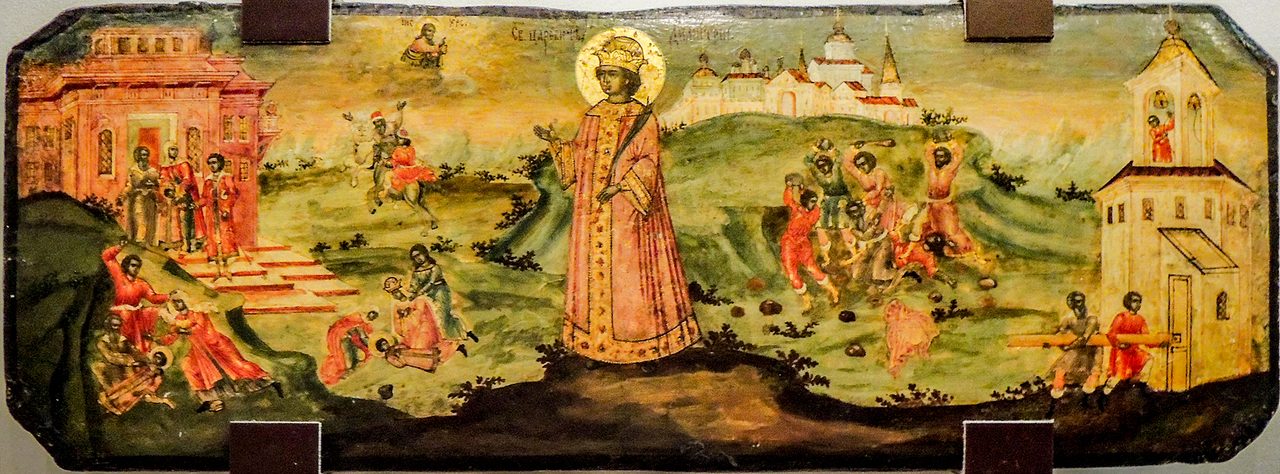 "Demetrius of Thessaloniki" — a birth-measure icon of Tsarevich Dmitry. Moscow Kremlin Museums
An official investigation led by Boyar Vasily Shuisky concluded that the death was accidental. However, a popular rumor accused Boris Godunov of murder, alleging he was clearing his path to the throne. This theory gained particular traction following the appearance of impostors claiming to be the "miraculously saved tsarevich".
Dmitry’s canonization in 1606 was initiated by the new tsar, Vasily Shuisky. The motivation was not merely religious, but also political: it was necessary to dispel rumors that the tsarevich was still alive and to discredit the impostors. Dmitry was revered as an innocent "passion-bearer" who had perished at the hands of assassins. His relics were solemnly transferred from Uglich to the Cathedral of the Archangel in the Moscow Kremlin and he was formally canonized as a saint.
In the 17th century, Tsarevich Dmitry became one of Russia's most venerated saints. Icons depicting him were distributed throughout the country and he was regarded as a heavenly patron of Russian princes and a protector of the state.
Why was Ivan Ivanovich (1554–1581) not canonized?
Ivan the Terrible had an eldest son by Anastasia Romanovna: Tsarevich Ivan Ivanovich. He died at the age of 27 after being struck by his father’s staff during a fit of rage. Tsarevich Ivan Ivanovich was not canonized, because his death, however tragic, did not meet the criteria for Orthodox sainthood. He did not die as a martyr or a passion-bearer, but rather as the result of a family quarrel.
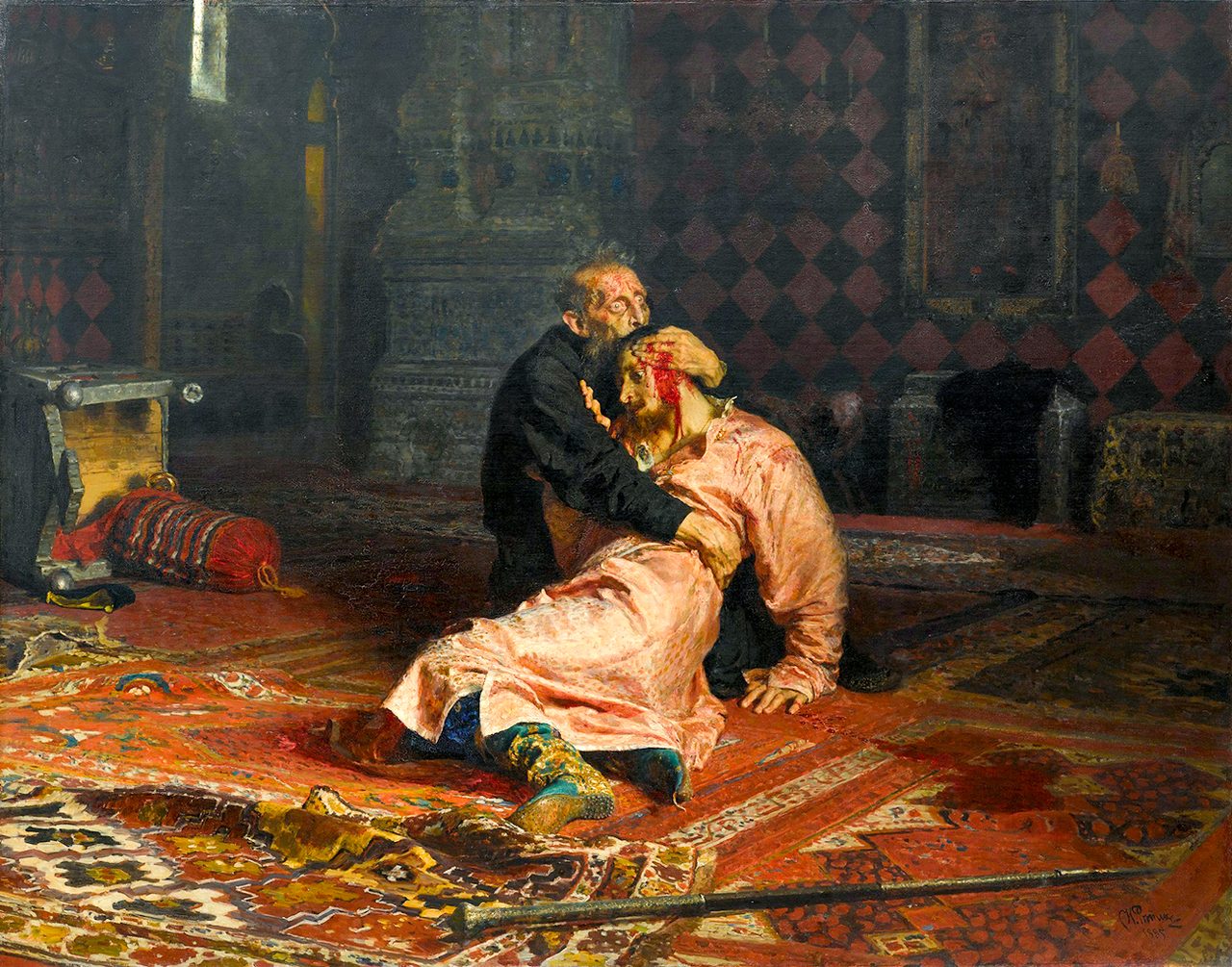 Ilya Repin. Ivan the Terrible and His Son Ivan on November 16, 1581