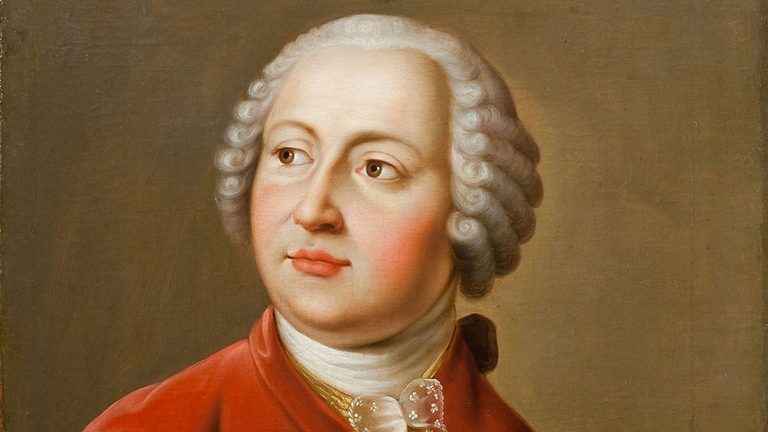
Why Russian scientist Mikhail Lomonosov acted like a hooligan

The first Russian scientist of global renown, a poet and reformer of the Russian language, was a hot-headed man prone to extremes.
Most people probably know that Mikhail Lomonosov (1711–1765) was a brilliant man born to a peasant family in the Arkhangelsk Governorate. At the age of 19, he set off on foot, accompanying a caravan of fish merchants, to study in Moscow, eventually becoming the man who laid the foundations of physical chemistry, formulated the law of conservation of matter, discovered the atmosphere of Venus, founded Moscow University and reformed the Russian literary language.
However, he was also notorious for his complex, contradictory and combative personality; he would drink himself into a stupor and engage in fights, not just with classmates in his youth, but also, in his later years, with fellow members of the Academy of Sciences.
Student revelry
After graduating from the Slavic-Greek-Latin Academy in Moscow in 1735, Lomonosov and 12 other students were sent to St. Petersburg and enrolled at the university affiliated with the Academy of Sciences. A year later, he was sent to Marburg to study the fundamentals of metallurgy, chemistry and other natural sciences.
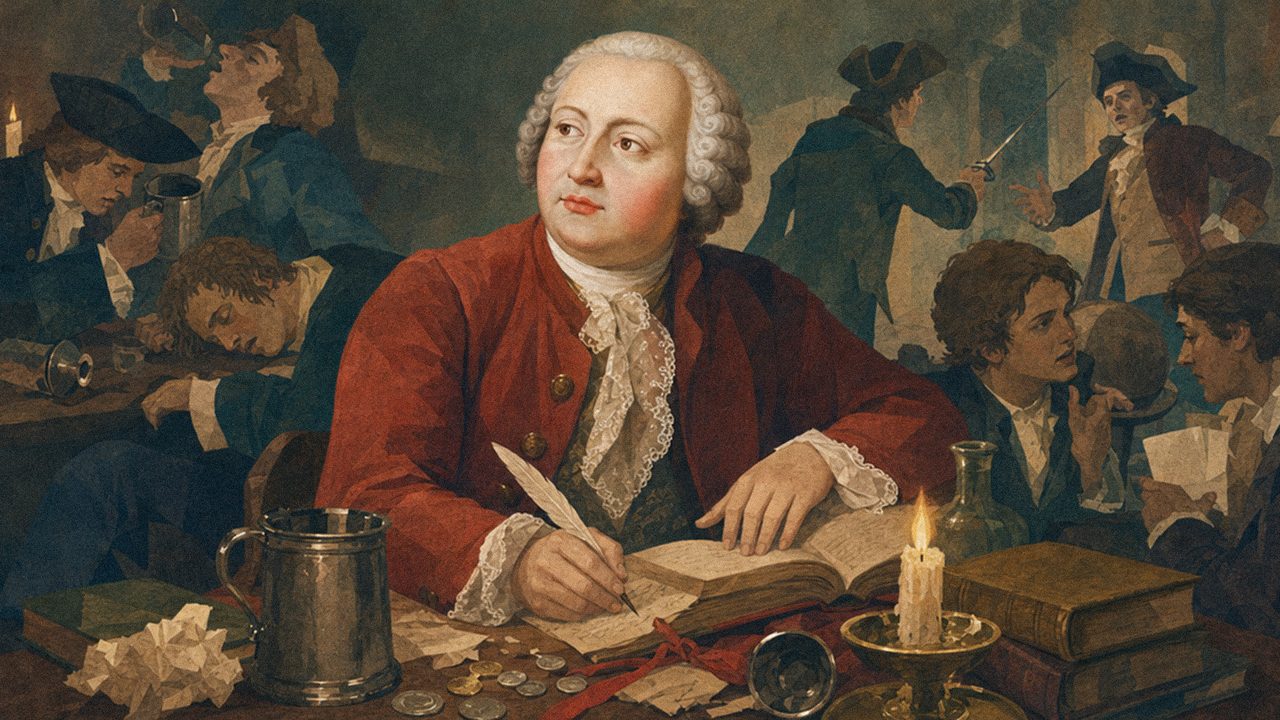
In Germany, he took up residence in the home of a German brewer’s widow—whose daughter he would later marry. His life there was as vibrant and contradictory as his own nature: years of intense study under some of Europe’s greatest minds were interspersed with bouts of debauchery, mounting debts, and extraordinary escapades. At that time, the University of Marburg was renowned for its permissive atmosphere: carousing, brawls, and even duels were commonplace. Lomonosov possessed a robust constitution and a volatile temper; records indicate that he would drink and behave so rowdily that he occasionally ended up in the university’s lock-up.
Recruitment into the Prussian Army and Escape
The most adventurous episode from this period was his enlistment in the Prussian army. Lomonosov had been traveling from Germany toward the Netherlands, intending to return to Russia by sea. Along the way, near Düsseldorf, he stopped at an inn and encountered a group of Prussian soldiers led by a recruitment officer. They invited him to dine and drink at their expense, all the while singing the praises of serving the Prussian king. According to one account, they simply got him so drunk that he lost consciousness, then dressed him in a uniform and forced him to shake hands—a gesture that symbolically sealed the enlistment agreement. Another version suggests that, swayed by their persuasion and the influence of the wine, he agreed to join of his own accord.
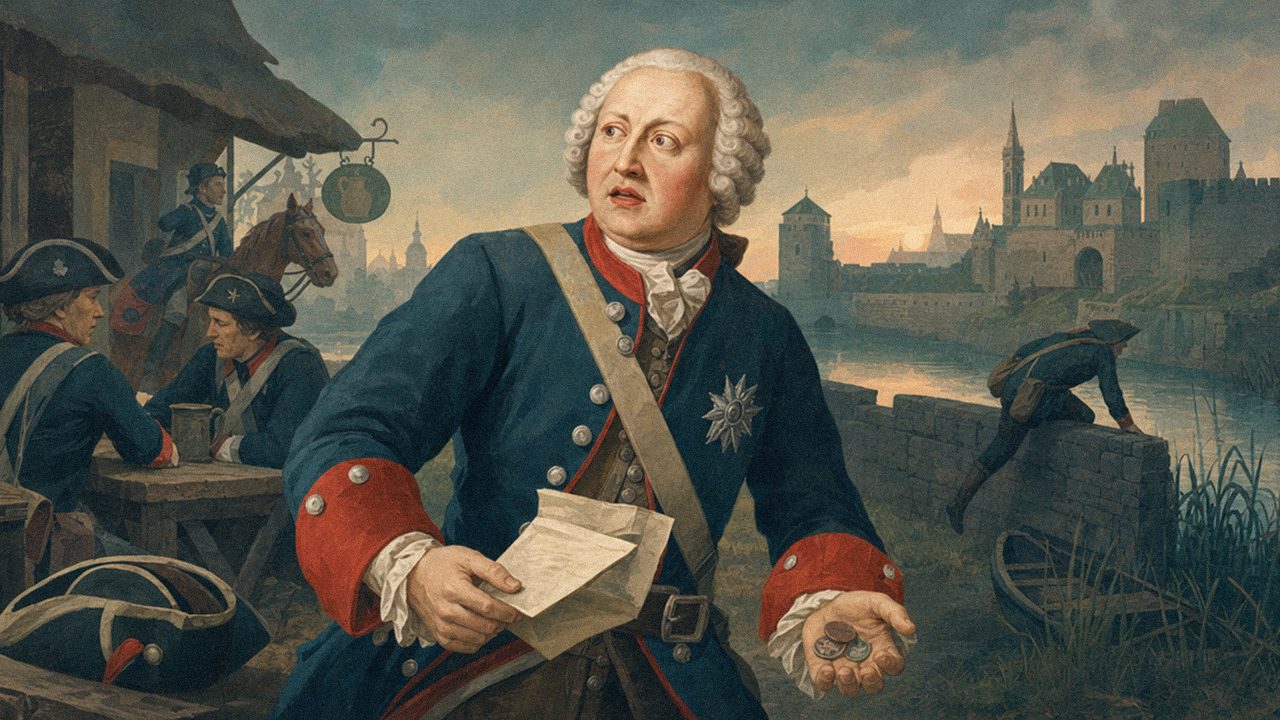
He awoke to find himself wearing the uniform of a Prussian cavalryman, carrying documents in someone else’s name, and with a few Prussian coins in his pocket. Thus, a promising young scholar became a soldier in the army of Frederick the Great.
Lomonosov was sent to the fortress of Wesel. Realizing that his service could drag on for years, he began to feign great zeal—pretending to thoroughly enjoy his duties—in order to lull his superiors into a false sense of security. Once a favorable opportunity arose, he climbed over the fortress wall in the early morning, swam across the moat, and—still in his sodden clothing—ran some ten kilometers to the border, narrowly evading capture.
A Fight with the Gardener
His hot temper did not leave him even in his mature years, by which time he was already a member of the Academy of Sciences.
One of the most scandalous episodes took place in September 1742. Lomonosov, an adjunct at the Academy, burst into the home of the Academy’s gardener, Johann Sturm—with whom he had long-standing conflicts as a neighbor (Sturm also moonlighted as a moneylender, and Lomonosov was in his debt).

According to an official complaint filed by Sturm with the police, Lomonosov was in an extremely aggressive state. He struck one of the gardener’s guests on the head, then grabbed a wooden post and began hitting everyone present with it. Even the gardener’s pregnant wife was struck; in her terror, she jumped out a window. To top it all off, he used his sword to hack at mirrors and doors.
Lomonosov later claimed that the incident was sparked by slander allegedly uttered by one of Sturm’s guests, but this hardly justified such violent behavior. As a result of the incident, he was arrested and spent several months in custody (from June 1743 to January 1744), and his salary was cut in half as a disciplinary measure.
Miller’s Nose
His conflict with Gerhard Müller, an influential historian, was not merely personal but also scholarly: they argued fiercely over the "Varangian question" and the interpretation of Russian history.
On one occasion, during a heated debate, Müller laughed in response to one of Lomonosov’s arguments. Lomonosov began using abusive language, and, according to some accounts, the situation escalated into a physical altercation, during which Lomonosov broke Müller’s nose. This episode became one of the most high-profile scandals within the Academy.

However, contemporaries noted that in that era, quarrels—and even physical altercations—among learned men were not particularly rare and rarely came as a shock to anyone. Yet, the scale and intensity of Lomonosov’s confrontations set him apart, even against that backdrop.