Why is Mikhail Lomonosov considered a great scientist?
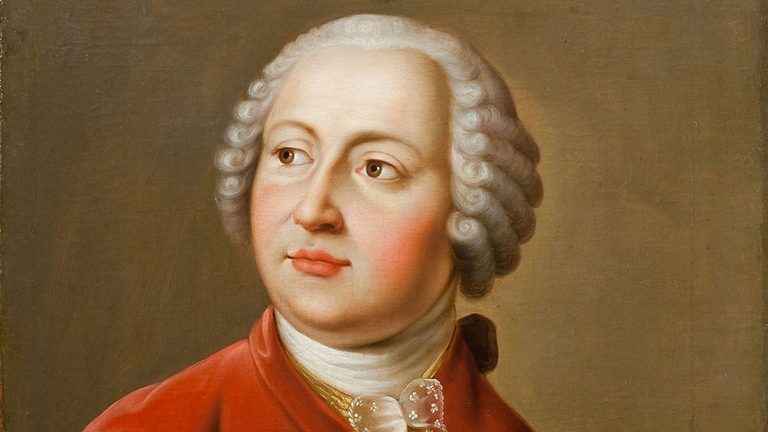
The son of a peasant from near Arkhangelsk walked all the way to Moscow on foot in pursuit of knowledge and became one of the first Russian scientists of global stature.
The future scientist and public figure was born in the village of Mishaninskaya in the Russian North. His father, a free and relatively prosperous peasant, made his living in the fishing industry, while his mother was the daughter of a church clerk; she was likely the one who taught the boy to read and write. And he read everything he could get his hands on – —starting with whatever religious texts and books he could find among his neighbors. In his quest for deeper knowledge, he even joined the Old Believers and studied at their school for a time, though he soon left.
In 1730, at the age of 19, his father decided to marry him off to the daughter of a wealthy man from Kola – a remote, isolated outpost – which would have effectively put an end to any prospect of the young man’s further development. Determined to escape, Lomonosov borrowed money, paid a bribe to obtain a passport (without which it was impossible to travel within Russia) and departed the Arkhangelsk Governorate, joining a caravan of fish merchants. Then, he spent weeks traveling on foot to Moscow, where he enrolled in the Slavic-Greek-Latin Academy. To gain admission, he had to resort to a ruse, claiming to be the son of a nobleman. He quickly mastered the curriculum and excelled in his studies, despite living in extreme poverty on a meager scholarship.
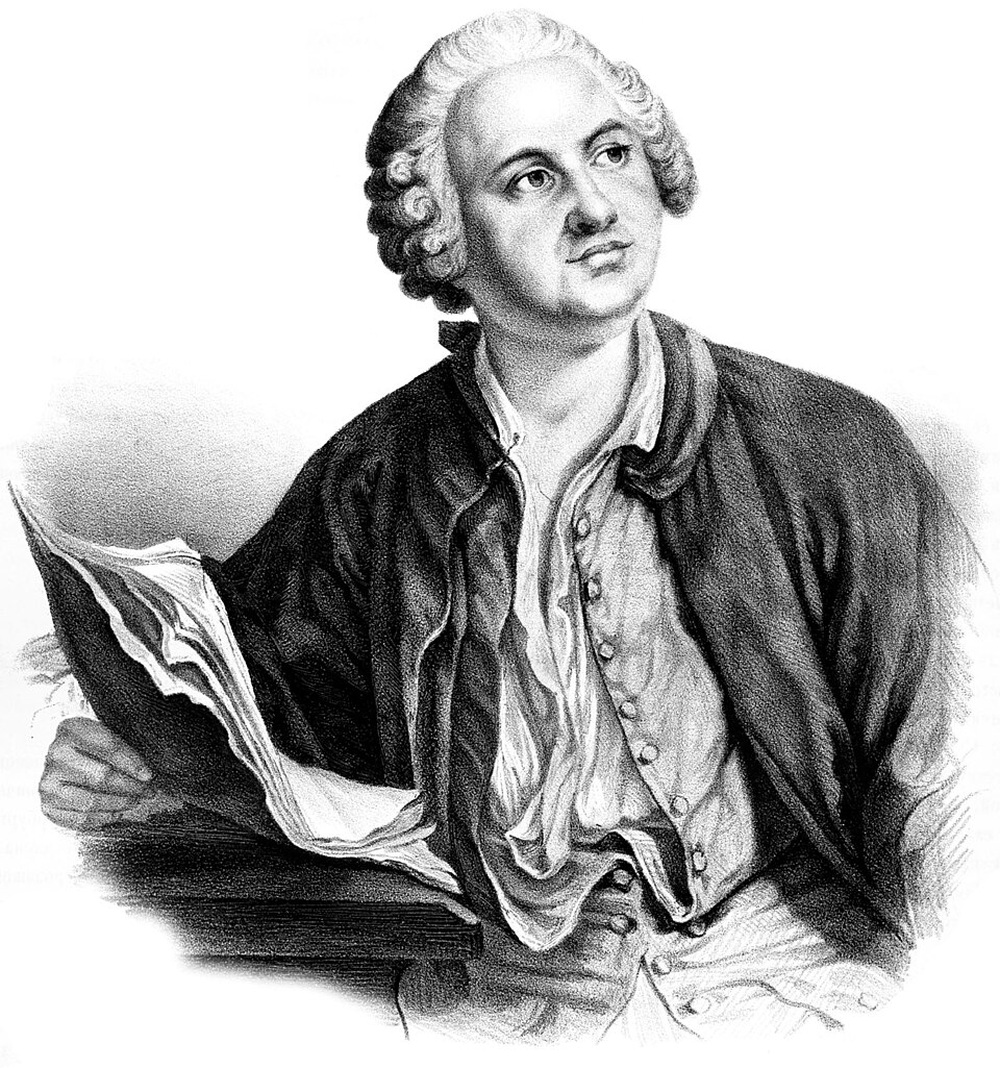
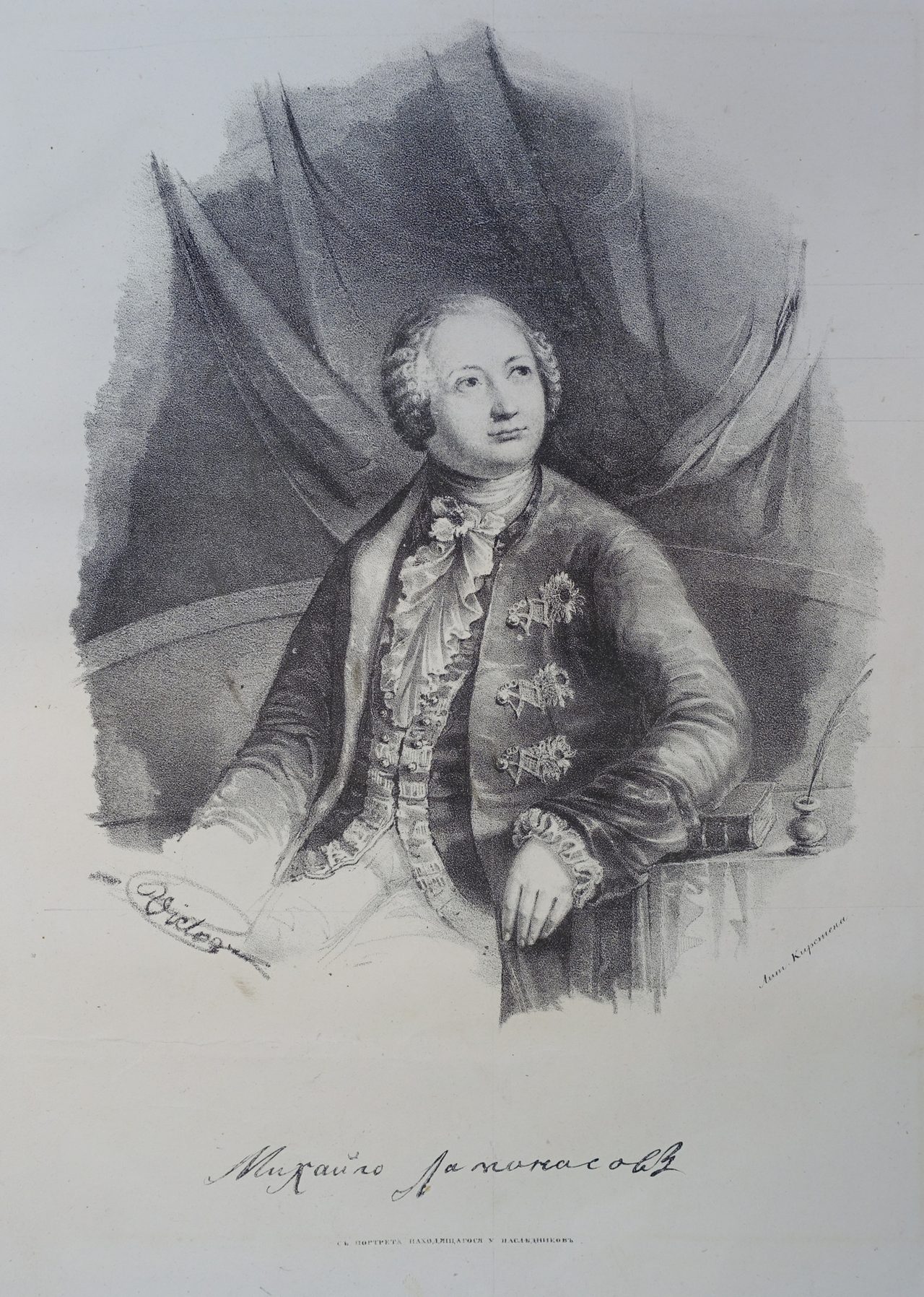 Portrait of Mikhail Lomonosov. Illustration from the book "Sketches of Russia." 1840. Author: Vadim Passek
In 1735, he was offered a position at the Academy of Sciences in St. Petersburg. There, he studied German and the fundamentals of physics and chemistry and was, subsequently, selected to study mineralogy in Germany. He spent three years in Marburg under the tutelage of Christian Wolff, one of Europe’s most prominent educators at the time.
Achievements in the Natural Sciences
A year before his death in 1765, Lomonosov summarized his work by compiling a list in Latin of his achievements in the natural sciences. Among other things, he credited himself with the following:
His treatise ‘Reflections on the Causes of Heat and Cold’, in which he advocated for the kinetic theory of heat, according to which the temperature of a body depends on the speed of its constituent particles. In the 18th century (and even later), many believed in the existence of a distinct substance called ‘caloric’ (or ‘heat fluid’). Lomonosov, however, proved to be correct.
He also wrote a dissertation on the causes of air elasticity, explored the theory of solutions and made significant contributions in the field of metallurgy (his textbook on the subject was groundbreaking by global standards). He contemplated the age and structure of the Earth's crust, described the continents and attempted to calculate the age of the Earth, estimating it to be 400,000 years.
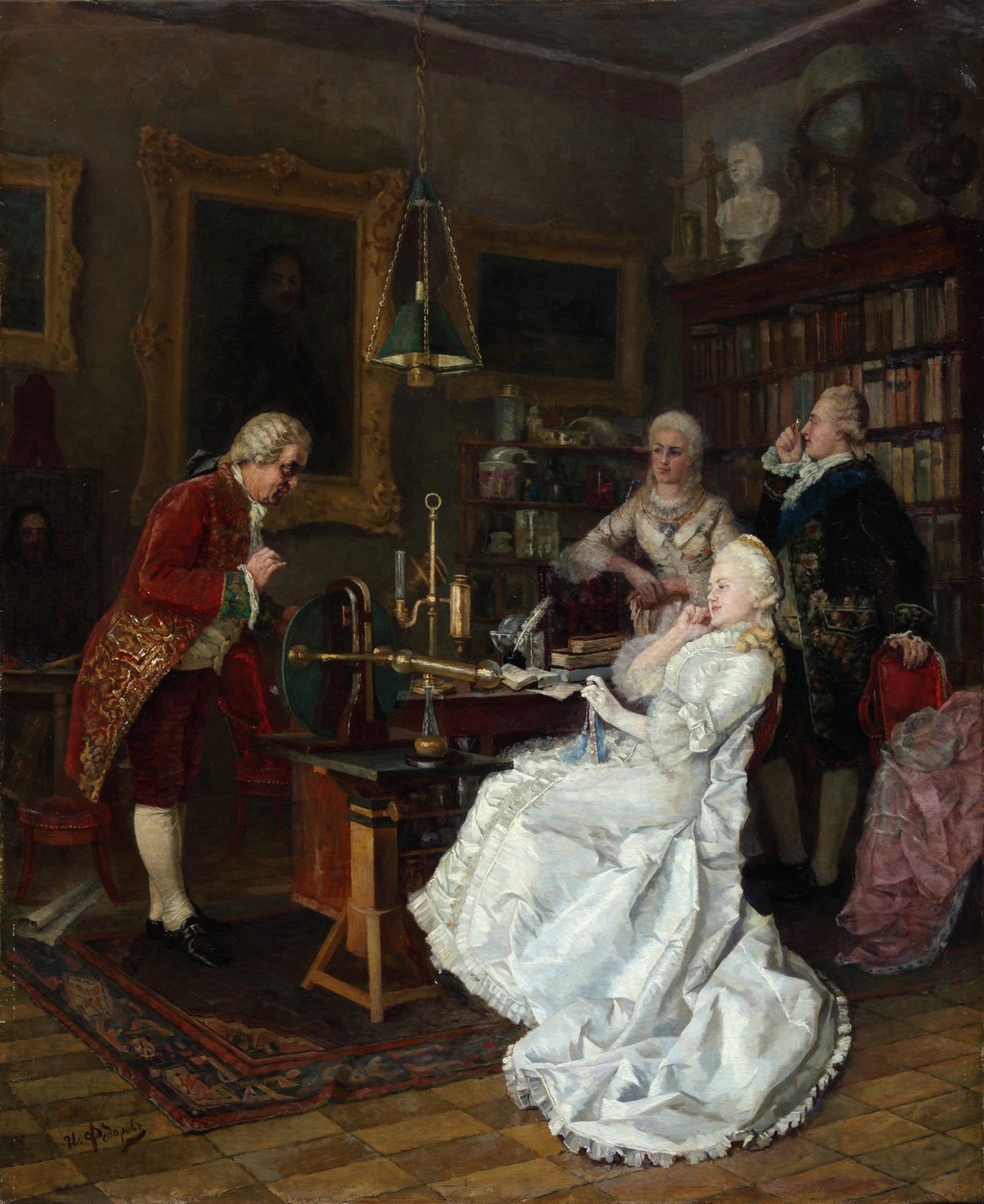 Empress Catherine II visits the scholar Mikhail Lomonosov, 1884. Private collection. Artist: Ivan Fedorov
Research in the field of electricity: From the 1740s onward, Georg Richmann was his friend and assistant. Together, they conducted experiments in the fields of heat, cold and the study of thunderstorms. While Lomonosov excelled as a theorist, Richmann was a gifted experimentalist and mathematician. Lomonosov expanded upon Benjamin Franklin’s ideas, proposing that the aurora borealis is electrical in nature. They invented "lightning machines" to study how objects become electrified during thunderstorms. In the early 1750s, during one of these experiments, Richmann was “killed by a lightning strike”. In his work ‘On the Origin of Color and the Number of Colors’, Lomonosov expanded upon the ideas of Descartes and Mariotte, identifying three primary colors: red, yellow and blue. He was a proponent of the wave theory of light (associated with Huygens), which stood in contrast to Newton’s corpuscular theory. As time would reveal, both sides were, in a certain sense, correct. In his ‘Discourse on Greater Precision in Determining a Sea Route’, he reflected on the fact that the force of Earth’s gravity fluctuates and that these variations could be measured and utilized for navigation.
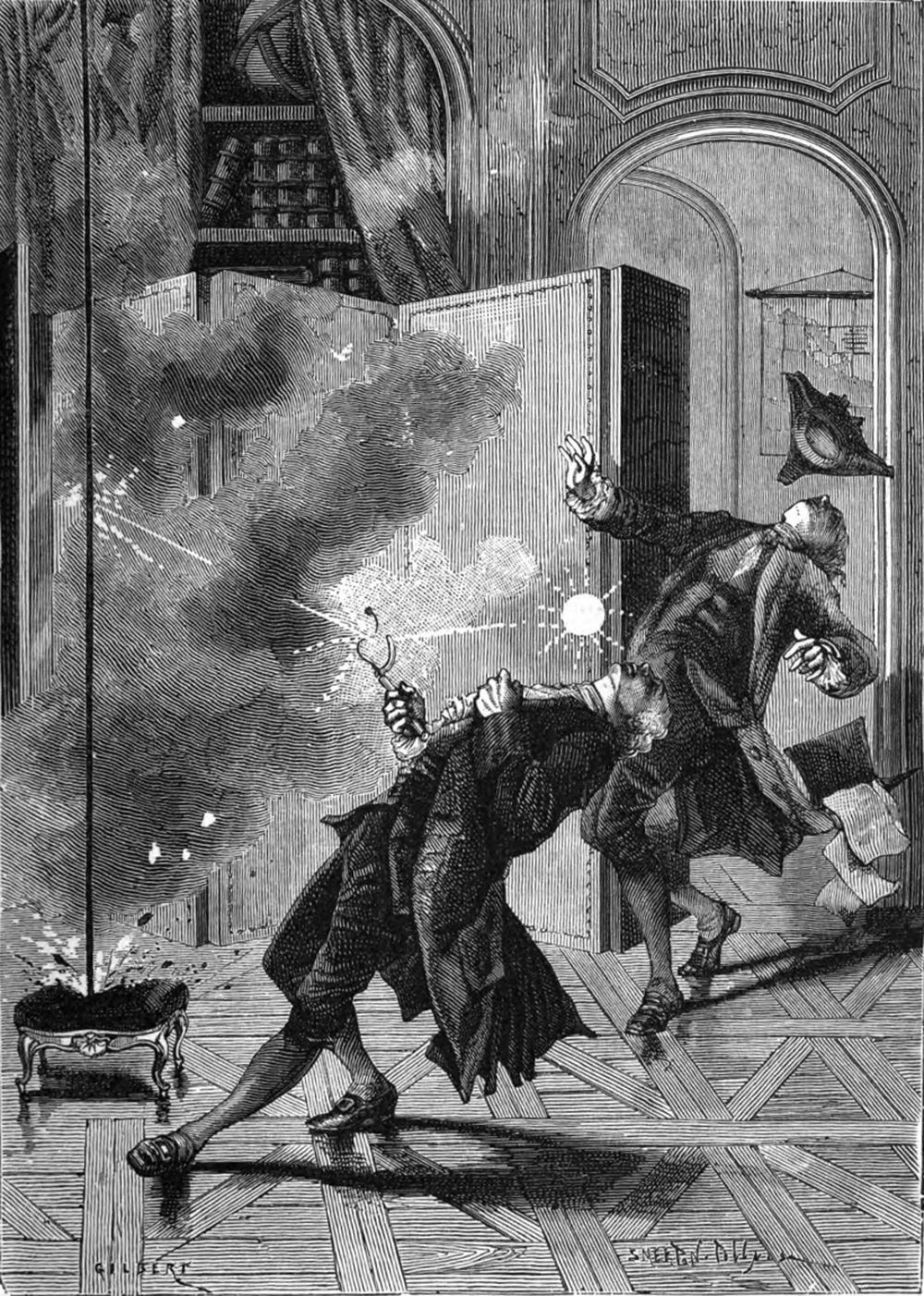 The tragic death of Richmann
Lomonosov, along with Lavoisier (though working independently) demonstrated the validity of the law of conservation of matter.
One of his most remarkable achievements was the discovery of an atmosphere on Venus. He delivered a lecture on this subject at the Academy, even suggesting the potential existence of intelligent life there. It was not until the 20th century that scientists confirmed the actual presence of an atmosphere on Venus.
The ‘Three Styles’ and Moscow University
Lomonosov’s greatness was not confined to the natural sciences. He played a pivotal role in the formation of the modern Russian literary language, authoring the first truly scholarly ‘Russian Grammar’ (1755), which drew upon the living, spoken language. His theory of the "three styles" brought order to literary registers and he himself became the author of celebrated odes and poems.
Lomonosov was the first Russian scientist to participate in scientific discourse as an equal; he debated, reached consensus and collaborated with his European counterparts on equal terms. He held his own distinct perspective—one that frequently proved correct, often anticipating the conclusions reached by his contemporaries.
Perhaps Lomonosov’s most famous achievement in Russia is the founding of Moscow University in 1755. He did not merely propose an idea; he also developed a detailed plan to establish an educational institution accessible to gifted students from various social backgrounds. Today, it is one of the country’s leading universities, bearing his name.