

This linguist could teach anyone any language in just a few hours
As a child, Andrey Zaliznyak was told he had no talent for languages. But, it turned out he was a true genius and he was the one who even taught computer systems to recognize Russian.
The word ‘Окно’ (window). A noun, inanimate, neuter gender, 2nd declension (declension type 1*d according to A. A. Zaliznyak’s classification).
If you type any Russian word into a search engine, the results will invariably list its grammatical characteristics, including the A. A. Zaliznyak classification type. But, who is this mysterious person?
A talent for language
Andrey Zaliznyak (1935–2017) was a linguist and a specialist in the Russian language and its history, who was also fluent in English, French, Swedish, Arabic… and even ancient Persian cuneiform!
Zaliznyak dedicated his entire life to linguistics, demonstrating the true zeal of a pioneer. The scholar literally even died at his desk, while making corrections to a manuscript.
He believed that any language could be learned literally in a few hours, even Arabic. And he devised his own system, which he successfully tested on students.
His passion for languages began completely by chance. Once, as a schoolboy recovering from a concussion, Andrey was bored at home. A French textbook caught his eye and, out of boredom, he learnt it by heart.
Teaching computers to read
Zaliznyak graduated from the Philological Faculty of Moscow State University and went to France on an exchange program. There, he was offered to teach Russian as a foreign language. While pondering how to explain declensions to the French, he created his own dictionary on cards and, from this, the idea for a new classification was born.
Zaliznyak’s ‘Grammatical Dictionary of the Russian Language’ later became the foundation for spell-checking and text recognition in the first Russian computer search systems.
A specialist in ancient languages
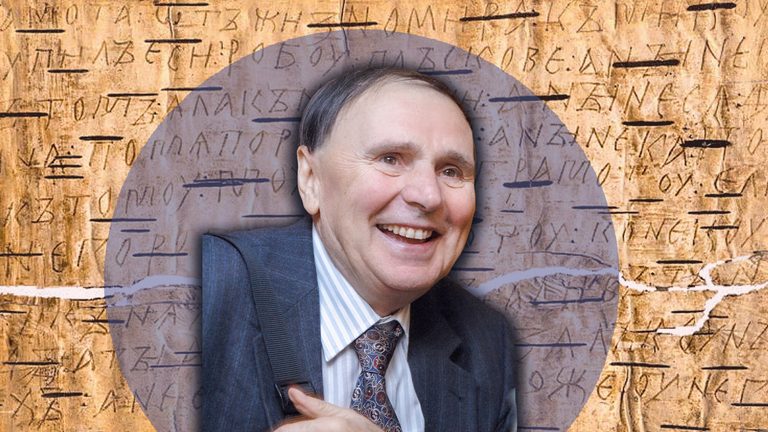
One of Zaliznyak’s greatest passions was the birch bark manuscripts of Old Russia. He became fascinated with them completely by chance, when a friend showed him some. Eventually, these vivid messages from the 11th–12th centuries became one of his scientific interests and he even deciphered a manuscript that the entire Academy of Sciences had struggled with for nearly 40 years.
As a result, this “armchair” linguist began traveling on expeditions to Veliky Novgorod in search of new manuscripts and his lectures on the findings at Moscow State University drew packed audiences.
Zaliznyak also meticulously studied ‘The Tale of Igor’s Campaign’, one of the oldest monuments of Russian literature and ultimately received the State Prize for this work. He took on the task merely out of curiosity – to determine whether the document was authentic or not, as this debate had arisen too often in public discourse.
But, Zaliznyak’s focus was not limited to Old Russian; he also studied Sanskrit, Ancient Hebrew, Old Indian and other languages.