

What did the ‘Chumaks’ (aka traders) do in Russia?
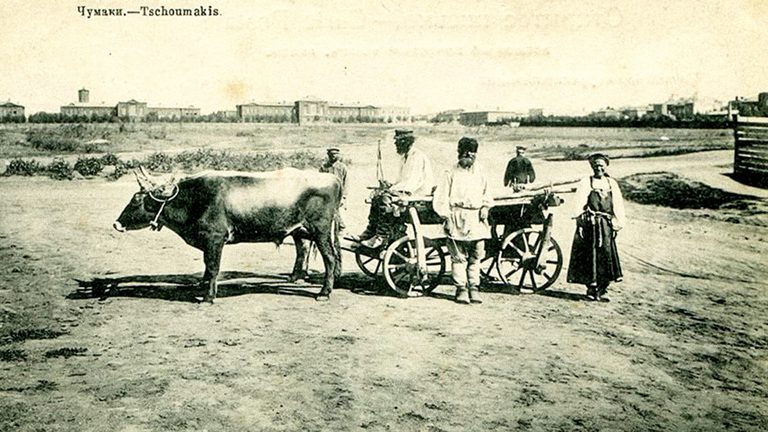
‘Chumak’ trading was a dangerous, exclusive and very profitable business.
The ‘Chumaks’ made quite an impressive sight: rugged men escorting a convoy of carts pulled by two or four Bessarabian oxen with long horns. Each cart could carry over 60 poods (approx. 1,500 pounds) of salt. The economy of the southern Russian Empire relied heavily on the ‘Chumaks’. The main purpose of their long-distance expeditions was to extract and transport salt from the Crimean and Azov estuaries, as well as from Lakes Elton and Baskunchak. Without this preservative, it was impossible to preserve and store meat and fish for long periods.
In addition to salt, they could transport salted fish (from the Don and Volga rivers), as well as bread, hides, honey and wax. They traveled along well-established routes – the ‘Chumak’ trails. These ‘Chumak’ trails led to Odessa, the Crimea and the Don. From Sloboda Ukraine, the chumaks traveled north as far as Moscow and northeast as far as Nizhny Novgorod.
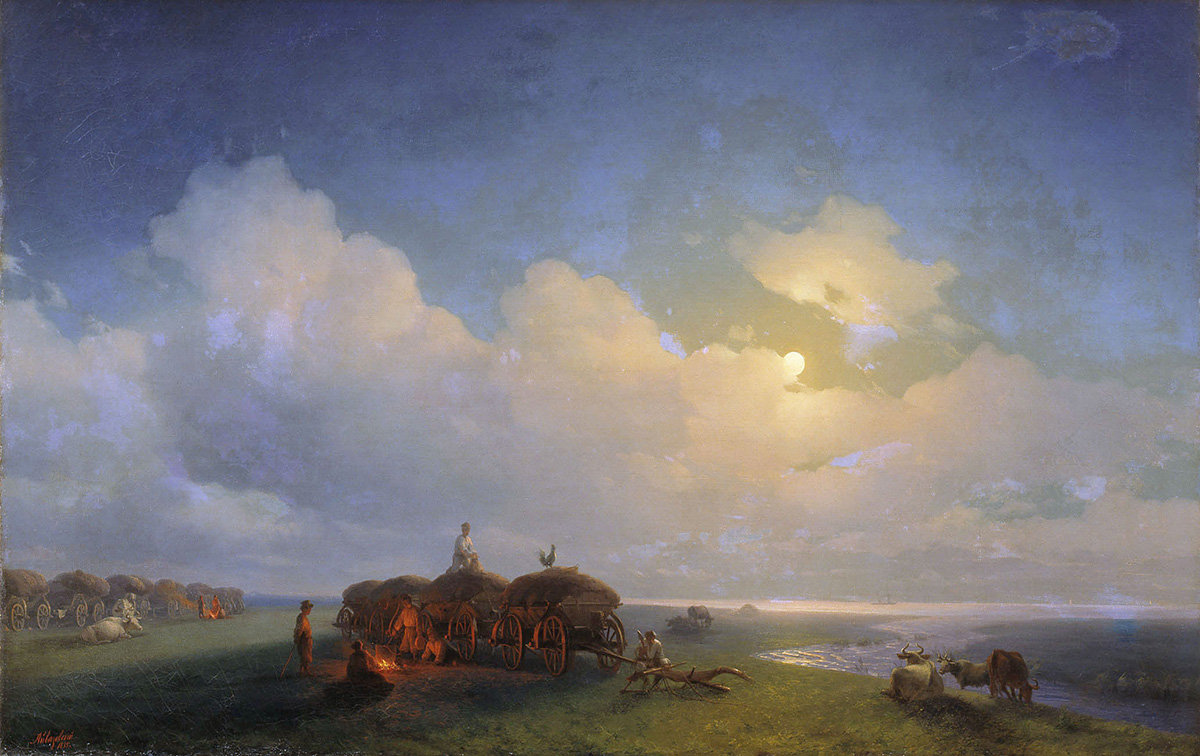 Ivan Aivazovsky. Chumaks at Rest
‘Chumak’ trade – that is, the business of trade and transportation – was primarily carried out by men in Little Russia and southern Russia during the 16th–19th centuries. Researchers believe that the word ‘chumak’ is borrowed from Turkic languages, where it means a mace or a long stick. However, ‘chumak’ trade was not merely a transport business, but an entire culture with its own laws, way of life and even folklore (the so-called ‘chumak songs’ are well known).
People from all walks of life were involved in this trade – from wealthy peasants and townspeople to Cossacks and even serfs, who earned money this way to pay their taxes. The income was so good that families whose men were ‘chumaks’ usually didn’t even grow their own grain: they kept livestock for meat and milk, raised poultry and harvested hay for the winter. There was no need to cultivate the land – it was easier to buy bread and vegetables.
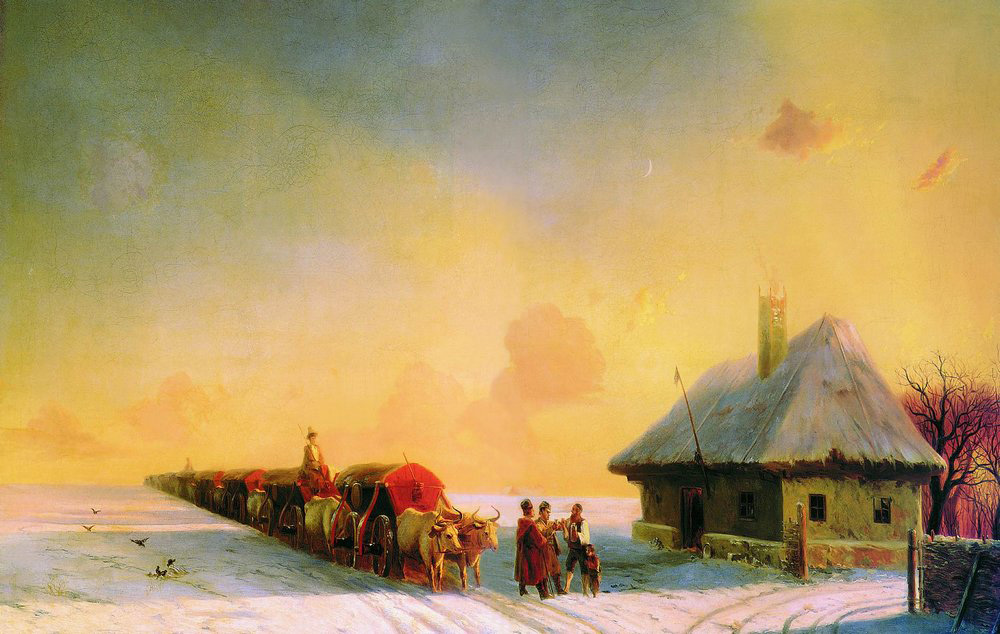 Ivan Aivazovsky. Chumaks in Little Russia. 1885.
There was also danger: due to the constant threat of attacks by nomads and bandits, ‘chumaks’ never traveled alone. They united into large, armed convoys called ‘valkas’ (from 15-40 to 100-300 carts or wagons). Among the skills of a ‘chumak’ was proficiency and familiarity with cold steel (bladed weapons) and firearms.
A ‘valka’ was a well-organized unit. At its head was an elected ataman – an experienced man who knew the route, assigned responsibilities and duties and settled disputes. There were also certain "infrastructure" positions, such as a cook (kitchen or porridge maker), who carried provisions and kitchenware and prepared meals for everyone. Another important member of the expedition was a rooster, which served as a living clock and sometimes as a navigator – in foggy conditions, it would help the team find their way back to the wagon train.
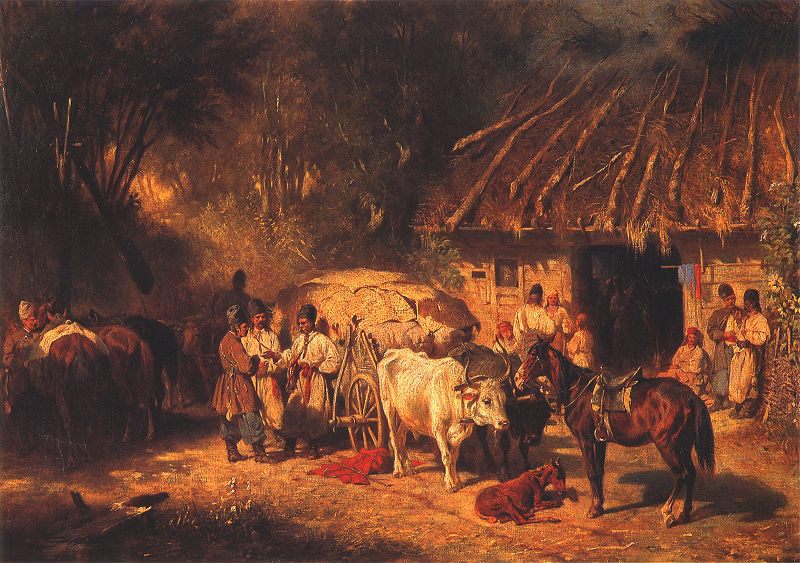 Jozef Brandt. Chumaks at a halt in front of the tavern. 1865
The main drawback of ‘Chumak’ transport was its slow speed; nevertheless, it was considered quite reliable. However, by the mid-19th century, the ‘Chumak’ trade began to decline, due to the spread of railroads. Trains proved to be a much faster, cheaper and more efficient way to transport goods. By the end of the century, the profession had virtually disappeared.